What does Kihon Involve?

Kihon examples
Strikes (tsuki and uchi), kicks (geri), blocks (uke), stances (dachi), and footwork transitions form the core technical elements of kihon. These fundamental techniques are rigorously drilled – both in isolation and in various combinations – to build and refine the essential qualities required in karate: correct form, explosive power, precise timing, dynamic balance, and controlled breathing.
In traditional practice, these movements are often executed in lines, with students moving forward and backward across the dojo in unison. This method of repetition not only conditions the body but also instills a strong sense of rhythm, spatial awareness, and group discipline. Each technique, whether a simple punch or a complex combination, is an opportunity to correct posture, deepen stance, improve hip rotation, and align breathing with movement.
Strikes like tsuki (straight punches) and uchi (open-hand or circular strikes) train focus and penetration, while kicks such as mae geri (front kick), yoko geri (side kick), and mawashi geri (roundhouse kick) develop leg strength, flexibility, and timing. Blocking techniques (uke), including rising blocks, inward and outward blocks, and sweeping deflections, train both defense and the ability to transition into counterattacks. Stances (dachi) such as zenkutsu dachi (front stance), kokutsu dachi (back stance), and kiba dachi (horse stance) provide the structural integrity needed for both offence and defence, anchoring techniques with stability and power.
Equally important is footwork and transitional movement – the glue that connects all techniques fluidly. Learning to shift weight, pivot, slide, and advance or retreat efficiently allows a karateka to maintain balance and control in motion, preparing them for the unpredictable nature of real combat. Through relentless kihon training, these elements are internalised and refined over years, forming the technical backbone of all karate practice.

Why Kihon Matters?
Kihon is far more than just basic movement – it is the very engine that drives all of karate. It is through kihon that we first learn to move with purpose, to strike with intention, and to root our techniques in structure and balance. These foundational drills condition both the body and the mind, developing strength, coordination, stamina, and above all, focus. Kihon sharpens precision and cultivates correct form, forging habits through repetition until movement becomes instinctive – muscle memory born not of haste, but of discipline and attention to detail.
Without solid kihon, even the most elaborate kata becomes nothing more than empty choreography – lacking timing, rhythm, and spirit. Likewise, kumite without a foundation in kihon falls apart under pressure, becoming wild and ineffective, stripped of control and awareness. This is why even senior karateka, regardless of rank or experience, continue to return to kihon. It is not a beginner’s practice to be discarded, but a lifelong companion that reinforces the core principles of the art.
Kihon teaches patience, builds resilience, and brings clarity to technique. It reminds us that mastery is not found in complexity, but in the refinement of the fundamentals. Through kihon, we reconnect with the essence of karate: strong basics, sharp mind, and an indomitable spirit.
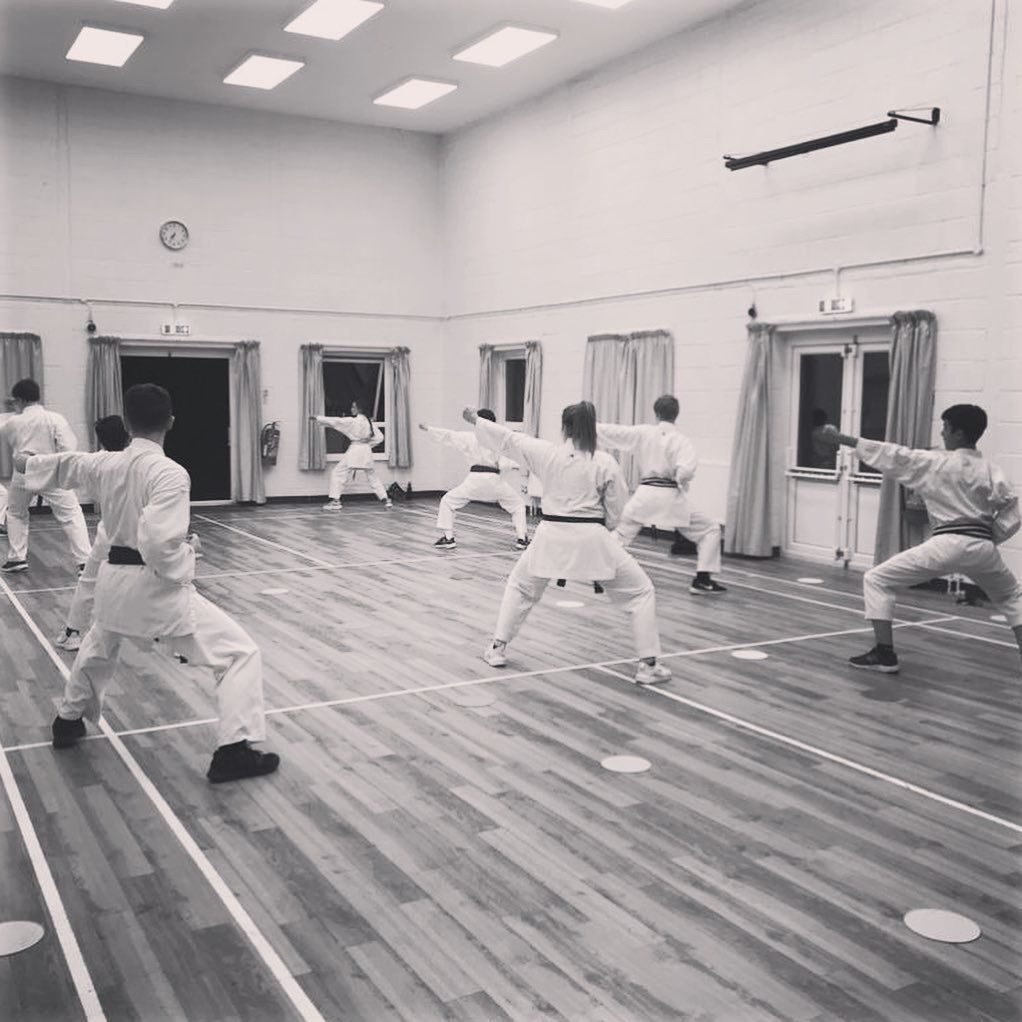
In essence
Kihon is the bedrock upon which all true karate is built. It is not merely the repetition of basic techniques, but the disciplined forging of body, mind, and spirit through fundamentals. Without strong kihon, even the most advanced kata or kumite becomes hollow – movement without substance, form without power. A karateka who neglects kihon is like a warrior without a stance: unstable, vulnerable, and lacking the grounding needed to respond with strength or clarity. Mastery of technique begins and ends with kihon, for it shapes our posture, balance, timing, and intent. In the heat of combat or the quiet of practice, it is kihon that holds everything together. To overlook it is to build on sand – everything else eventually falls apart.